
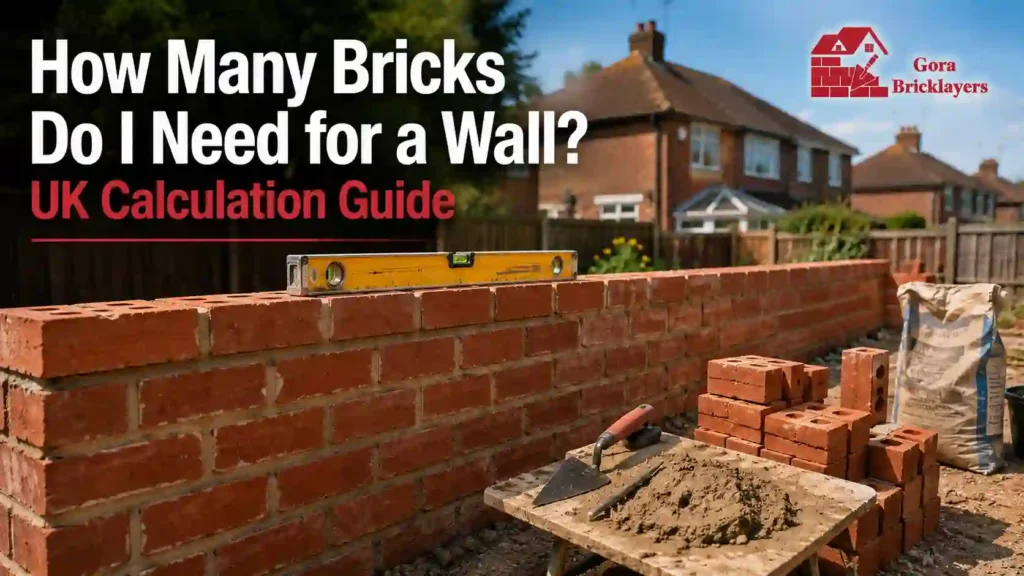
Working out how many bricks a wall needs is one of the first questions every self-builder asks before ordering materials. Homeowners planning a garden wall building service or a boundary rebuild face the same question. Getting the sum wrong can stall a project or waste a delivery charge on extra bricks. Gora Bricklayers answers this question for Birmingham homeowners every week. This guide breaks the maths down clearly, with real UK figures and a worked cost example for 2026.
How Many Bricks Do You Need Per Square Metre for a UK Wall?
A standard UK metric brick measures 215mm long, 102.5mm wide, and 65mm high. Add a 10mm mortar joint on each face. This gives a coordinating space of 225mm by 75mm on the wall. That single fact underpins almost every brick calculation.
For a single skin wall, laid in the common stretcher bond, this works out to 60 bricks per square metre. A double skin wall is two brick leaves thick, so the figure doubles to 120 bricks per square metre. These two numbers cover most garden walls, boundary walls, and cavity wall outer leaves built across the West Midlands.
How Do You Calculate the Total Number of Bricks for Your Wall?
The full calculation starts with measuring the wall area. Multiply the wall length by its height, both in metres, to get the area in square metres. A wall that is 6m long and 1.8m high covers 10.8m².
Next, multiply that area by the bricks-per-m² figure for the chosen wall type. Gora Bricklayers walks every client through this exact sequence on-site, before a single brick gets ordered for a Birmingham build. For the 10.8m² example above, a single skin wall needs 10.8 x 60. That comes to 648 bricks before wastage is added.
Three paragraphs are enough for the core sum. The next section covers what happens once doors and windows break up that clean wall area.
How Do You Account for Windows, Doors, and Other Openings?
Few real walls are solid brick from end to end. Doors, windows, and gate openings all reduce the number of bricks actually needed. Skipping this step leads to over-ordering.
Measure the width and height of each opening and multiply them together to get its area. Add up all the opening areas. Subtract that total from the full wall area before multiplying by the bricks-per-m² figure. A single external door opening of roughly 1.98m by 0.86m works out to about 1.7m². That is around 102 bricks that do not need to be bought.
This step matters most on extensions and new builds. Several openings can remove hundreds of bricks from the total order. Garden and boundary walls usually only need this adjustment for a single gate.
Does the Brick Bond Change How Many Bricks You Need?
Brick bond is the pattern the bricks are laid in, and it changes the final count. Stretcher bond is where every brick shows its long face. It is the most economical option, and the default for most modern garden walls and cavity wall leaves.
English and Flemish bonds mix header bricks, turned to show their short end, in with the stretchers. This produces a solid, full-thickness wall with strong structural performance. The cost is around 82 bricks per m², rather than 60. Exterior wall construction on older Birmingham properties often calls for one of these solid bonds to match existing period brickwork.
Anyone matching a Victorian or Edwardian terrace should check the existing bond before ordering. Guessing wrong changes the total by more than a third. Gora Bricklayers regularly matches these older bonds on period properties around Edgbaston, Moseley, and the wider Birmingham suburbs.
Working out exact brick quantities takes an on-site measure, not a rough guess. That applies to a Birmingham extension or a new boundary wall alike. Call 07574 580332 or get in touch for a free, measured brick and material count. Pricing is based on the exact wall being built.
How Much Wastage Should You Allow When Ordering Bricks?
No wall uses its exact calculated brick count. Cutting bricks at corners, piers, and reveals always creates some waste. A handful of bricks also break on site, regardless of how careful the team is.
Standard UK practice adds 5% to 10% on top of the base figure. Simple stretcher bond walls with few openings sit at the lower end. Flemish bond, English bond, and anything with heavy cutting sits closer to 10%. For the 648-brick example wall above, that means ordering between 680 and 713 bricks rather than exactly 648.
Running short mid-build causes real delays, since brick colours and batches can vary between deliveries weeks apart. A slightly generous wastage allowance is cheaper than a mismatched repair later.

How Much Mortar Will the Wall Need?
Bricks are only half the materials list. A single skin wall needs roughly 0.022m³ of mortar per square metre, with a standard 10mm joint. A double skin wall needs about double that volume. For the 10.8m² example wall, that works out to around 0.24m³ of mortar. At a common 4:1 sand to cement ratio, this needs roughly 0.38 tonnes of building sand. It also needs three to four 25kg bags of cement.
Getting the mix wrong is a common site error. Too much cement can crack softer bricks. Too weak a mix will not hold up outdoors through a UK winter. Matching the mix to the brick type matters as much as the bricks per m² figure.
Coping courses along the top of a wall are measured differently. Standard metric bricks laid flat give 5 bricks per linear metre. Bricks stood on end for a soldier course give 14 bricks per linear metre.
What Does It Cost to Buy Enough Bricks for a Wall in 2026?
Brick prices vary by type, finish, and supplier, so total material cost depends heavily on which brick you choose. The table below sets out typical 2026 UK price ranges per 1,000 bricks.
Using the 681-brick garden wall example from earlier, standard facing bricks cost £400 to £900 per 1,000. That puts the materials cost between roughly £270 and £610. This 2026 garden wall cost guide breaks down the full labour and materials picture for Birmingham gardens in more detail.
How Many Bricks Do Common Birmingham Garden and Boundary Walls Need?
Real wall sizes vary widely, from a low garden border to a full-height boundary wall. The table below shows brick counts, including a 5% wastage allowance. These are wall sizes seen regularly across Birmingham and the West Midlands.
Full guidance on boundary wall costs in Birmingham covers pier spacing, foundation depth, and labour rates. This applies to the double skin example above. Boundary walls over 1m next to a road, or 2m elsewhere, usually need piers. These go roughly every 3m for stability against wind loading.
Do You Need Planning Permission Before Building the Wall You Are Pricing?
Brick quantities are only half the planning picture. Most garden and boundary walls count as permitted development in England. This means you don’t need a planning application, provided you respect the height limits.
The general rule allows a wall up to 1m high next to a road used by vehicles. Elsewhere on the property, the limit rises to 2m. Conservation areas and listed buildings can override these limits, so it pays to check first. The official Planning Portal guidance on garden walls provides full detail. It covers exceptions and the application process for householders.
Confirming permission before ordering avoids buying bricks for a wall that later needs to be reduced in height or repositioned.
Should You Work Out the Bricks Yourself, or Ask a Bricklayer to Check the Numbers?
Manual calculation works well for a simple rectangular wall with no openings. Anyone comfortable with basic multiplication can measure the wall and calculate the area. They can then apply the 60 or 120 bricks per m² figure without much difficulty.
Complications appear fast once bond patterns, openings, piers, and mixed brick sizes enter the picture. A wall with several deductions and a solid bond can easily be miscalculated by a hundred bricks or more. That either wastes money or stalls the build. Getting a second set of eyes on the sum before ordering removes that risk entirely.
A quick site visit from an experienced bricklayer usually settles the question in minutes. It uses the actual wall, rather than an estimate from a tape measure alone.
Getting Your Brick Count Right Before You Order
Working out how many bricks a wall needs comes down to two numbers. That is 60 per square metre for a single skin, and 120 for a double skin. Then adjust both figures for bond, openings, and wastage. Getting those figures right before ordering saves both money and delivery delays.
Gora Bricklayers has helped homeowners across Birmingham and the West Midlands turn these sums into finished walls for years. That includes garden walls, boundary walls, and extensions. Once the last brick goes in, curing still takes time. This guide explains what to expect and how long new brickwork takes to dry and cure. A quick call before ordering bricks is the simplest way to avoid running short.
Get an exact, measured brick count for any Birmingham wall project. Call Gora Bricklayers on 07574 580332 or 07577 478379. The team also takes queries by contacting the office directly, with free quotes and no obligation to book.
Frequently Asked Questions
How many bricks do I need for a 6 metre long garden wall?
A 6m long, 1.8m high single skin garden wall covers 10.8m² of total face area. At 60 bricks per m² plus 5% wastage, that comes to around 680 bricks in total. Add more bricks for piers or a gate opening. A double-skin design would need roughly 1,360 bricks instead for extra strength.
Why does a double skin wall need twice as many bricks as a single skin wall?
A double skin wall uses two full brick leaves, built one behind the other, for extra strength and load capacity. Each leaf needs its own 60 bricks per m². The combined total doubles to 120 bricks per square metre. A wastage allowance for cuts and breakages then gets added on top.
How many bricks per square metre does an English or Flemish bond wall need?
English and Flemish bonds mix header bricks with stretchers to build a solid wall face, unlike a stretcher-only skin. This raises the standard UK metric figure to around 82 bricks per m². That compares with 60 bricks per m² for a simple stretcher bond wall of the same overall size.
Do I need to add extra bricks for wastage on a small garden wall?
Yes, even small walls need cuts at corners, piers, and gate openings, plus the odd breakage while laying bricks. Adding 5% to 10% on top of the base brick count avoids a delivery delay partway through. Running short on a small Birmingham garden wall build wastes both time and money.
How much does it cost to buy enough bricks for an average UK garden wall in 2026?
A 10.8m² single skin garden wall needs about 680 bricks, including a standard 5% allowance for wastage and cuts. At £400 to £900 per 1,000 for standard facing bricks, that is roughly £270 to £610 for materials alone. Mortar, sand, and labor costs get added separately on top of that.
Can I trust an online brick calculator instead of working the sums out myself?
Online calculators handle standard bond types and brick sizes accurately for most straightforward UK garden walls. Always double-check openings, bond choice, and brick size by hand before ordering. A local bricklayer can also confirm the exact count during a free site visit.


