
Birmingham’s Victorian terraces are among the most sought-after properties in the city. They are also among the most maintenance-intensive. The brickwork on homes built between 1850 and 1901 behaves differently from anything built after the 1950s.Fixing problems the wrong way costs more than leaving them alone.
Gora Bricklayers works on Victorian brickwork across Birmingham every week, covering everything from failed mortar joints to structural arch repairs. This guide covers the five most common problems and what each one costs to put right in 2026. Getting the specification correct matters as much as the repair itself.
Getting the specification correct matters as much as the repair itself, brick repointing in Birmingham covers what the process involves from the first visit through to completion.
Why Victorian Brickwork in Birmingham Needs a Different Approach
Victorian bricks were handmade from local clay and fired at lower temperatures than modern engineering bricks. The result is a brick that is softer, more porous, and more responsive to moisture than anything produced after 1920. Birmingham’s Victorian housing stock uses predominantly blue engineering bricks at the base course and softer red stock bricks above. That combination creates predictable failure patterns when the wrong repair materials are applied.
The original mortar was lime-based. It was typically a mix of lime putty and sharp sand with a low compressive strength. That softness was deliberate. The mortar was designed to be weaker than the brick. It would absorb movement, allow moisture to pass through, and erode before the bricks did. When cement mortar replaces lime in a Victorian wall, that balance reverses. The joint becomes harder than the brick it sits against.
Birmingham’s West Midlands clay soils add a third factor. Seasonal shrink-and-swell movement in the ground stresses brickwork differently from chalk or sandy soils further south. Diagonal cracking and stepped cracks through mortar joints are more common on Birmingham clay than elsewhere in England. Movement around bay window bases is another predictable failure point on these properties.
Problem 1: Failed Mortar Joints
Failed mortar joints are the most common brickwork problem on Victorian Birmingham properties. They are also the most likely to cause secondary damage when ignored. Lime mortar typically lasts 50 to 80 years in normal conditions. Many properties in Bordesley Green, Nechells, Saltley, and Duddeston have not been repointed since the mid-20th century. These show predictable failure across all exposed elevations.
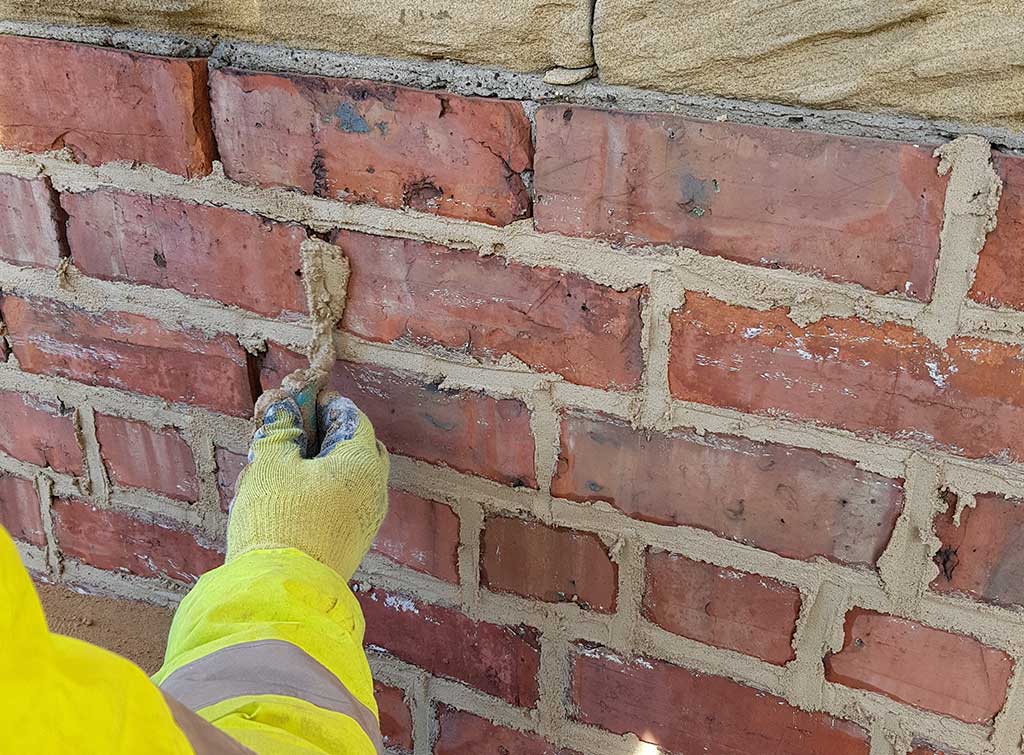
Repointing a Victorian property requires a lime-compatible mortar rather than standard cement. Using cement mortar on soft Victorian brick traps moisture inside the brick face, accelerating spalling rather than preventing it. For most Birmingham Victorian terraces, the correct specification is a hydraulic lime mix, NHL 2 or NHL 3.5. This must be matched to the original joint colour and profile. Gora Bricklayers assess the existing mortar on site before specifying any mix. An incorrect mortar choice causes expensive failures within a few years.
The cost to repoint a Victorian terrace in Birmingham depends on the number of exposed elevations, height, mortar type, and access. A mid-terrace with two exposed elevations and lime mortar repointing typically costs £1,800 to £4,000 in the current Birmingham market. An end-terrace with three exposed faces runs £3,000 to £6,500. These figures include scaffold erection and removal but exclude chimney work, which carries its own separate access cost.
Problem 2: Spalling Bricks
Spalling is where the face of a brick separates and falls away in layers or chips. It is directly caused by water saturating the brick and then freezing inside it. As the water expands during a frost event, the force pops the outer surface off the brick. Victorian handmade bricks are far more vulnerable to this cycle than modern dense-fired bricks. Their internal structure is more porous.
Spalling on a Birmingham Victorian terrace is almost always a downstream consequence of failed mortar joints. Once the mortar stops protecting the joint, water enters the brick directly. Left through several Birmingham winters, this destroys the brick face entirely. The repair requires cutting out each affected brick, sourcing a compatible replacement, and bedding it in lime mortar. Getting the brick match right on older Victorian properties takes experience. The original bricks were made from local clay. Off-the-shelf modern bricks rarely match in colour, texture, or porosity.
Spalling brick replacement in Birmingham runs from £15 to £30 per brick for standard red stock brick. This price includes labour and matching materials. In conservation areas in Edgbaston or Sutton Coldfield, heritage brickmakers must be sourced. The cost rises to £40 to £70 per brick in those cases. A wall with 50 spalled bricks across the front elevation costs £750 to £3,500 to restore. The range reflects brick type, height, and access.
Problem 3: Brick Arch and Lintel Settlement
Victorian properties used brick arches or simple brick lintels over most window and door openings. Timber and later concrete lintels arrived in the Edwardian period. These arches depend on the compression of surrounding brickwork to stay in place. When the supporting masonry moves, the arch loses compression and the mortar joints open. Birmingham’s clay subsoil is a common cause of this movement.
The tell-tale signs of arch or lintel movement are diagonal stepped cracks above window or door corners. Sagging brickwork above the opening, or visible gaps between arch bricks and the surrounding wall, also indicate movement. These are not cosmetic issues. Once movement begins, the opening loses its structural support and the brickwork above can deflect progressively without intervention.
When an arch or lintel fails on a Victorian Birmingham property, Gora Bricklayers carries out a full brickwork assessment before specifying the repair. Replacing a failed brick arch or fitting a new steel lintel typically costs £800 to £1,800 for a standard ground-floor window opening. This includes temporary support, lintel supply and installation, and brick reinstatement above the opening. Upper-floor openings requiring scaffolding run £1,500 to £2,500. Chimney repointing in Birmingham often reveals related arch movement at the chimney stack base. The same settlement forces affect the stack connection with the main wall.
Problem 4: Efflorescence and Salt Attack
Efflorescence is the white powdery deposit that forms on the face of Victorian brickwork when water carries soluble salts through the wall and deposits them on the surface as it evaporates. It looks cosmetic. It is not. Efflorescence is a reliable indicator that water is moving through the brick and mortar system in significant volume, and the salt crystals it leaves behind cause progressive damage to the brick face.
Salt crystallisation is particularly aggressive on Victorian handmade bricks. Their softer internal structure offers less resistance to salt expansion. Each time water moves through the wall, dissolves salt, and then dries out, the crystals grow slightly larger. Over time, this sub-surface pressure flakes the outer face of the brick from the inside out. This process resembles spalling but has a different root cause and a different remedy.
The correct treatment is to identify and seal the water entry point through repointing, not to apply surface treatments to the brickwork face. Surface treatments applied over active salt attack trap the salt behind an impermeable layer, which accelerates internal damage. The mortar joint is the correct point of moisture management in historic masonry, not the brick face.
Problem 5: Rising Damp at the Base Course
Rising damp at the base course of Victorian properties in Birmingham has two common causes. The first is a failed damp proof course. The second is ground levels raised above the original DPC by later landscaping, paving, or soil build-up. Victorian builders installed early DPCs from slate, bitumen, or engineering brick. These had a lifespan of 60 to 100 years. Many are now failing or have been bridged by later alterations.
The base course brickwork on affected properties shows distinctive damage patterns. Mortar joints at ground and first brick course level deteriorate faster than the rest of the wall. The brick stays permanently damp. Salt efflorescence appears as a tide mark at 600 mm to 900 mm above ground level. The mortar becomes powdery and soft. In severe cases, the brick face begins to blow at the base of the wall before any other elevation shows deterioration.
Remediating rising damp requires addressing the moisture source before any brickwork repair. That typically means installing a new chemical DPC injected into the base course mortar joints. External ground levels must be reduced where they have been raised over the years. The base course brickwork is then repointed with a hydraulic lime mix appropriate to the damp exposure conditions. Repointing the base course without addressing the DPC first means the fresh mortar fails within two to three years.
What Victorian Brickwork Repairs Cost in Birmingham (2026)
The table below reflects verified 2026 market pricing for each common repair type. All prices include labour and materials. Scaffold is included where stated. Prices reflect the Birmingham and wider West Midlands market and should be used as a planning guide rather than a fixed quote, as site conditions, access, and brick specification all affect the final figure.
| Repair Type | Typical Cost 2026 | Notes |
|---|---|---|
| Repointing (lime mortar, mid-terrace) | £1,800 to £4,000 | Two elevations, scaffold included |
| Repointing (lime mortar, end-terrace) | £3,000 to £6,500 | Three elevations, scaffold included |
| Repointing per m², lime mortar | £60 to £90 per m² | Victorian stock brick specification |
| Spalling brick replacement, standard | £15 to £30 per brick | Red stock brick, matching included |
| Spalling brick replacement, conservation | £40 to £70 per brick | Heritage brick sourcing required |
| Brick arch or lintel repair, ground floor | £800 to £1,800 | Includes temporary support and reinstatement |
| Brick arch or lintel repair, upper floor | £1,500 to £2,500 | Scaffold required |
| Chimney stack repointing | £500 to £1,200 | MEWP or scaffold access |
| Rising damp treatment and base course repoint | £1,500 to £4,000 | Depends on length of affected wall |
All prices are Birmingham 2026 estimates. Prices vary depending on specification, site access, ground conditions, and brick type. Gora Bricklayers covers repair and repointing work for bricklayers across Birmingham and the West Midlands, from inner-city terraces to larger detached properties across the region.
Why the Wrong Fix Makes Victorian Brickwork Worse
The most costly mistake made on Victorian brickwork in Birmingham is applying cement mortar over existing lime mortar joints. This happens regularly when homeowners use general builders unfamiliar with the material requirements of pre-1920 construction. Cement mortar applied over soft Victorian brick creates a rigid joint that is harder than the brick itself.
Moisture that would otherwise escape through the joint is forced through the brick face instead. The brick becomes the sacrificial material rather than the mortar. The result is progressive spalling within a few winters. This costs far more to remedy than correct lime repointing would have done from the start.
The second common error is applying a waterproof coating or masonry paint to the external face of Victorian brickwork. These products prevent evaporation through the wall face. In a solid-wall Victorian property with no cavity, moisture has nowhere to go except inward. Internal damp follows quickly. Stripping these coatings is skilled work. Done incorrectly, it damages the brick surface and adds remediation cost on top of the original problem.
The SPAB guidance on repointing and mortar repair for older buildings confirms that the mortar joint is the correct point of moisture management in historic masonry. Targeted repair at the correct specification is consistently more effective and less costly than addressing structural deterioration after it has set in.
Conclusion
Victorian brickwork in Birmingham fails in predictable patterns. Failed mortar joints are the root cause of the majority of secondary problems, including spalling bricks, salt attack, and penetrating damp. Addressing mortar failure with the correct lime-compatible specification prevents the cascade of more expensive repairs that follows when the wrong fix is applied or when the problem is left to develop through another winter.
Gora Bricklayers works specifically on Victorian and Edwardian properties across Birmingham, from the dense terraced streets of Small Heath and Bordesley Green to the larger detached Victorians in Harborne and Edgbaston. For homeowners planning their repair budget in detail, the guide to what to budget for Victorian brickwork repairs gives a thorough breakdown of what each type of work costs and what drives the final figure up or down.
Frequently Asked Questions
Q1. What is the most common brickwork problem in Victorian houses in Birmingham?
Failed mortar joints are the most common problem by a significant margin. Victorian properties in Birmingham were built with lime mortar that has a lifespan of 50 to 80 years in normal conditions. Many properties in areas such as Bordesley Green, Saltley, Small Heath, and Nechells were built in the 1870s to 1900s and have either never been repointed or were repointed at some point with an incompatible cement mix. That cement mortar traps moisture and accelerates brick deterioration, meaning failed mortar joints often appear alongside early-stage spalling, giving the impression of two separate problems that actually share a single root cause. Addressing the mortar specification correctly is the first and most important step on any Victorian property.
Q2. Why do I keep seeing cement mortar used on Victorian houses if it causes damage?
Cement mortar became the default repointing material in the 1950s and 1960s when lime-based mixes fell out of common use. Many general builders in that era and since have used it on Victorian properties without understanding the difference in brick hardness and porosity between pre-1920 and post-1950 construction. The damage often takes several years to appear, by which point the original repointing contractor is long gone. The Society for the Protection of Ancient Buildings and Historic England have both published clear guidance on lime mortar specification for older buildings, but awareness of this guidance is uneven among general tradespeople. A specialist bricklayer with experience on Victorian housing stock will always start with a mortar assessment rather than assume a standard mix.
Q3. Can I live in my Victorian Birmingham home while brickwork repairs are being carried out?
In almost all cases, yes. External brickwork repairs are carried out from scaffold on the outside of the property and do not require access to the interior. Dust and some noise are involved, particularly during the joint raking-out phase, but the property remains habitable throughout. The main disruption is the scaffold itself, which can restrict light to windows on the affected elevation for the duration of the job. Most repointing contracts on a standard Birmingham terrace are completed within one to two weeks from scaffold erection to removal, depending on weather conditions and the area being treated.
Q4. How do I know if my Victorian Birmingham terrace needs full repointing or just patch repairs?
A bricklayer will carry out a simple on-site check to determine this. The standard method is to press a screwdriver tip into joints across different sections of the wall and at different heights. Joints that compress easily under light pressure, that are recessed more than 5 mm behind the brick face, or that shed powder when touched need repointing. Joints that resist the test and feel solid can be left undisturbed. Historic England’s guidance recommends targeted repair rather than full repointing wherever sound mortar remains, as disturbing sound lime mortar unnecessarily shortens the lifespan of the joints around the repaired area. A qualified bricklayer will map the affected sections and quote only for the work that is genuinely needed.
Q5. How long does lime mortar repointing last on a Birmingham Victorian property?
Properly specified and applied lime mortar repointing lasts 30 to 50 years in West Midlands conditions when the correct hydraulic lime grade is used and the joints are raked to the correct depth before the new mortar is applied. The key variables are mortar grade, joint depth, weather during curing, and whether moss and algae are managed on the brickwork in subsequent years. A common reason for premature failure is applying new mortar too thinly over old joints rather than raking them out to 15 to 20 mm depth. Thin application leads to loss within five to ten years. When the work is done correctly, lime mortar repointing is a long-term investment in the fabric of the building.
Q6. Do I need planning permission to repoint or repair brickwork on a Victorian Birmingham house?
In most cases, no. Repointing and brick repair on a standard Victorian terrace or semi-detached property in Birmingham falls within permitted development rights and does not require planning permission. The main exception is listed buildings, where any repair work to the external fabric, including repointing, requires listed building consent from Birmingham City Council before work begins. Properties within conservation areas may also have restrictions on materials and visible finishes, so it is worth checking with the planning department before specifying mortar colour and joint profile on any property in a designated area. A specialist bricklayer familiar with Victorian housing in Birmingham will advise on this as part of the initial assessment.


