
Mortar keeps Birmingham’s brick walls standing. When it starts to fail, the brickwork stops protecting the structure and lets water in. Gora Bricklayers see this problem across the city every week. It appears on Victorian terraces in Small Heath as regularly as on 1930s semis in Acocks Green.
Catching the five warning signs of failing mortar early saves homeowners significant money. Repair bills for advanced damage run far higher than the cost of a straightforward brick repointing services in Birmingham.
Why Birmingham Homes Are Particularly Vulnerable to Mortar Failure
Birmingham’s climate puts mortar under constant pressure. The city receives an average of 680 mm of rainfall per year, with west-facing elevations taking the heaviest exposure. Repeated wetting followed by frost in colder months accelerates mortar breakdown faster than in drier parts of England.
The housing stock adds to the challenge. A large proportion of Birmingham’s homes were built between 1850 and 1940. These used lime-based mortars that were softer and more permeable than modern cement. These original mixes are now well past their typical service life. Mortar failure is common across Bordesley Green, Saltley, Nechells, and similar inner-city neighbourhoods.
Properties in Sutton Coldfield and Edgbaston face a different pressure. Older buildings on clay-heavy ground are subject to seasonal movement. That movement stresses mortar joints at corners, around bay windows, and at chimney bases. This creates water entry points long before the damage becomes obvious from street level.
Warning Sign 1: Mortar That Crumbles or Powders at a Touch
Run a finger across the mortar joints on an external wall. Healthy mortar resists this test. Failing mortar will shed powder or crumble away with light pressure, leaving the joint face recessed behind the brick face.
This type of surface erosion is common on older Birmingham terraces where original lime mortar has reached the end of its lifespan. Lime mortars were designed to be sacrificial. They erode slowly over decades to protect the bricks themselves. When erosion has progressed to powdering, the joint can no longer redirect water away from the wall.
Pay close attention to north-facing and west-facing elevations. These surfaces dry out more slowly after rain, which accelerates mortar decay. A wall may pass the finger test on the front. It can still be failing on the side return or rear.
Warning Sign 2: Cracks Running Along the Mortar Joints
Cracks in mortar joints fall into two categories. Hairline cracks follow the joint line. Wider separations indicate that mortar has opened up significantly. Both are warning signs, but the wider the crack, the more urgent the situation.
Hairline cracks often appear first along horizontal bed joints, particularly in older properties where mortar has lost flexibility. These cracks allow water to enter during rain. During a frost event, trapped water expands and forces the crack wider. This cycle compounds quickly across a Birmingham winter.
Cracks that run diagonally across brickwork may indicate structural movement rather than simple mortar failure. The same applies to cracks that reopen after pointing has been applied. Professional bricklayers in Birmingham can identify the cause and advise on whether repointing or a structural survey is the correct next step.
Warning Sign 3: Damp Patches Appearing on Internal Walls
Damp appearing on internal walls after rainfall is one of the clearest signs that mortar failure has progressed past the surface. Water has moved through the wall and is now affecting the internal fabric of the property.
Bricklayers who carry out repointing inspections in Birmingham regularly find the same pattern. Homeowners have treated internal damp symptoms for months without tracing the problem back to the external mortar. Plaster repairs and redecoration provide no long-term fix until the water entry path is sealed. Gora Bricklayers carry out external inspections specifically to identify the joint sections responsible.
The most common locations for rain-driven damp from mortar failure are below window sills and at chimney breast walls. Ground-floor rear elevations on north-facing aspects are also vulnerable. Chimneys are a frequent culprit. Stacks that are overdue for chimney repointing in Birmingham track water directly into the ceilings and walls of the rooms below.
Warning Sign 4: White Staining on the Brickwork Face
A white powdery deposit on the face of bricks or along mortar joint edges is known as efflorescence. It appears when water moves through masonry, dissolves soluble salts inside the wall, and deposits them on the surface as the water evaporates.
Efflorescence is not a cosmetic issue. It confirms that water is actively travelling through the wall. On a sound wall with intact mortar, this volume of water movement does not occur. When mortar has failed, the path of least resistance shifts from the joints into the brick and block substrate.
Chimney stacks and chimney breast walls in Birmingham homes frequently show efflorescence first. It often appears on the external face before any other sign of mortar failure. Chimneys are exposed on all sides and dry at a different rate from the main wall. Addressing this failure point early prevents water tracking into the roof structure and damaging timbers and ceilings below.
Warning Sign 5: Missing Mortar, Gaps, or Vegetation in Joints
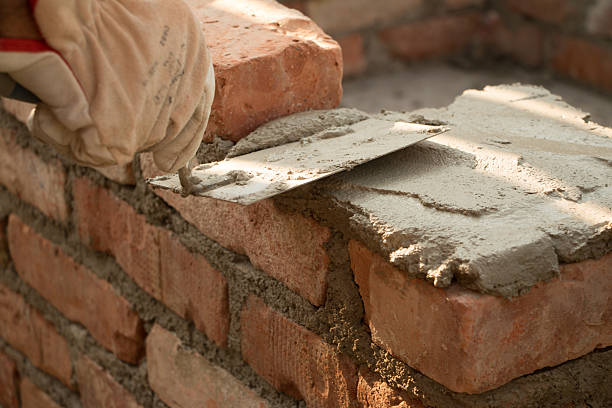
When mortar has eroded beyond powder and cracking, sections begin to fall out entirely. Visible gaps and joints open several millimetres deep represent advanced mortar failure. Areas where brick edges are fully exposed require the same prompt attention.
Vegetation growing from mortar joints is a further progression of the same problem. Moss, small ferns, and root systems exploit the moisture retained in open joints. Gora Bricklayers regularly remove established plant growth from Birmingham garden walls, chimney stacks, and party walls before repointing. Root systems physically widen joints and hold moisture against the brick face.
Missing mortar on exposed sections of brickwork becomes critical during cold spells. Gable ends, chimney stacks, and parapets are most at risk. Without mortar acting as a barrier, wind-driven rain enters the joint directly. Frost action on saturated masonry can then dislodge bricks entirely on walls left without maintenance for several seasons.
How to Judge Urgency at a Glance
| Warning Sign | Urgency Level | What It Means |
|---|---|---|
| Powdery, soft mortar at the surface | Monitor and book soon | Surface erosion has begun; water entry is increasing |
| Hairline cracks in bed joints | Book this season | Cracks will widen through freeze-thaw action |
| Wider cracks (over 2 mm) in joints | Act promptly | Significant water entry path; structural check advised |
| Damp on internal walls after rain | Act now | Water is already inside the wall fabric |
| Efflorescence on brickwork | Inspect within weeks | Active water movement confirmed through the wall |
| Missing mortar sections or open gaps | Urgent | No weather protection remaining at these points |
| Vegetation growing from joints | Urgent | Root damage is compounding the mortar loss |
What Failing Mortar Leads to If Left Alone
Mortar failure rarely stays contained to the joints. Once water has a reliable entry point, it moves through the wall and saturates the internal masonry. Over winter, repeated freeze-thaw cycles progressively damage brick faces through spalling. This is where the brick surface flakes or pops off in layers.
Spalled bricks are expensive to address because damaged bricks must be cut out and replaced rather than repointed. Matching original brick types on Birmingham’s older housing stock requires sourcing compatible materials. The total repair cost is substantially higher than the repointing that would have prevented it.
Water reaching internal walls brings secondary damage through plaster degradation and mould growth. In older properties, it also damages lath-and-plaster ceilings below leaking chimney breast walls. Targeted repair at the mortar stage is consistently more effective and less costly than addressing structural deterioration once it becomes visible.
Historic England guidance on repointing brick and stone walls is clear that sound mortar should be preserved and failing sections addressed early, before damage spreads to the surrounding masonry.
Conclusion
Failing mortar follows a predictable sequence. It starts as surface softening, progresses to cracking, then to open gaps, and finally to water damage inside the property. The five warning signs in this guide mark distinct stages in that sequence. Identifying them early means the remedial work remains straightforward and contained.
Gora Bricklayers has worked on brick properties across Birmingham and the West Midlands for years. The team covers Victorian terraces in Bordesley Green and Nechells, as well as suburban properties in Acocks Green and Sutton Coldfield. For homeowners in the early stages of mortar deterioration, the guide on brick repointing costs and what’s involved provides a clear picture of what professional remedial work requires.
Frequently Asked Questions
How do I know if my Birmingham home needs repointing or full brick replacement?
Repointing is the correct solution when mortar has deteriorated but the bricks themselves remain structurally sound. Full brick replacement becomes necessary when brick faces are spalling, crumbling, or showing frost damage deep into the substrate. In Birmingham’s older terraced stock, spalling is commonly the result of mortar failure left unaddressed long enough for water to reach the brick. An experienced bricklayer can assess which situation applies during a site inspection, usually within the first few minutes of examining the brickwork face and joint depth.
How often does mortar need replacing on a Birmingham terrace?
Original lime mortar in Birmingham’s Victorian terraced stock, built between roughly 1870 and 1920, has a lifespan of 50 to 80 years depending on exposure and maintenance history. Many properties in areas such as Saltley, Small Heath, and Bordesley Green are reaching or exceeding that threshold. Modern repointing using an appropriate hydraulic lime or lime-sand mix should then last another 30 to 50 years when applied to the correct depth and allowed to cure properly before frost exposure.
Can repointing be done on just one section of a wall rather than the whole property?
Yes. Targeted repointing of the worst-affected sections is entirely appropriate and is what Historic England recommends for older properties. Sound mortar should be left undisturbed. Repointing only the failing areas reduces cost and avoids unnecessary disturbance to original mortar that is still performing. A good bricklayer will identify which elevations and sections need attention and quote accordingly, rather than recommending full repointing of a property that does not need it.
Does failing mortar affect a Birmingham home’s energy efficiency?
It does. Open mortar joints allow air movement through the wall, which increases heat loss from internal spaces. This effect is most noticeable in older solid-wall properties without cavity insulation, which form a large part of Birmingham’s inner-city housing stock. Repointing restores the weather seal at the joint level and reduces air infiltration, contributing to improved thermal performance alongside other insulation measures.
Is efflorescence on my brickwork dangerous?
Efflorescence is a sign of water movement through the masonry and should not be ignored, but it does not represent an immediate safety risk. The concern is what it indicates: water is travelling through the wall in sufficient volume to carry and deposit salts on the surface. Treating the white staining cosmetically without fixing the underlying mortar provides no lasting benefit. The cycle will continue until the source of moisture entry is sealed through repointing or other appropriate remedial work.
What type of mortar is used for repointing older Birmingham homes?
The appropriate mortar type depends on the age and construction of the property. Older Birmingham homes built before 1920, particularly those using softer handmade or stock bricks, require a lime-based mortar rather than a modern cement mix. Using a cement mortar on these properties traps moisture inside the brick because the joint becomes less permeable than the brick itself, accelerating spalling rather than preventing it. Newer properties with harder engineering bricks or dense concrete blocks can accommodate a stronger cement-based mortar. A professional assessment of the existing mortar and brick type is the correct starting point before any mix is selected.


