
Cracks appearing in brick walls are one of the most common concerns Birmingham homeowners bring to brickwork repair specialists in Birmingham. Some cracks are cosmetic. Others signal something more serious beneath the surface.
Gora Bricklayers works across Birmingham and the West Midlands daily, and the cause of a crack is almost never obvious from a photo alone. This guide explains what the crack patterns mean, what causes them in Birmingham’s specific housing stock, and what to do next.
Why Birmingham Homes Are Particularly Prone to Brick Wall Cracks
Birmingham properties crack more than many homeowners expect, and there are two local reasons that every other guide on this topic ignores.
The clay subsoil problem under much of Birmingham
Large areas of Birmingham sit on Triassic red clay and Mercia Mudstone. Clay soil behaves differently from sand or chalk. It swells when it absorbs water in wet weather and shrinks when it dries out in summer. Birmingham’s wet winters followed by drier spells create a cycle of expansion and contraction in the ground beneath foundations. That movement transfers upward into the walls above.
This is not a dramatic sudden shift. It is slow, seasonal, and cumulative. A foundation that sits on clay is moving slightly every year in response to rainfall and temperature. The brickwork eventually shows the strain through cracking. Properties in Edgbaston, Moseley, Kings Heath, and Harborne are particularly exposed to this because of the clay geology across those areas.
The age and construction of Birmingham’s housing stock
Birmingham has one of the most varied housing stocks in England. Victorian and Edwardian terraces fill Handsworth, Sparkhill, and Aston. Inter-war semis dominate Sutton Coldfield, Great Barr, and Erdington. Post-war cavity wall properties are spread across Chelmsley Wood, Castle Vale, and Northfield. Each era was built differently, with different materials, and each has its own specific failure modes that lead to cracking.
A Victorian terrace in Handsworth has soft handmade bricks and lime mortar. A 1960s semi in Erdington has hard machine-made bricks, a cavity wall, and iron wall ties. What causes cracking in one is completely different from what causes cracking in the other. Understanding which era a property belongs to is the starting point for diagnosing any crack.
What Do Different Crack Patterns Actually Mean?
The shape and direction of a crack tells a skilled bricklayer a great deal about the cause before any investigation begins. The table below covers the most common patterns seen on Birmingham properties.
| Crack Pattern | Likely Cause | Typical Location | Urgency |
|---|---|---|---|
| Stepped crack following mortar joints diagonally | Differential settlement or subsidence | Corners, around openings | High: monitor or get assessed |
| Horizontal crack along mortar bed joints | Wall tie failure (cavity walls) or soil pressure | Mid-wall on outer leaf | High: structural cause likely |
| Vertical crack at corners or mid-wall | Thermal movement or foundation settlement | Gable ends, corners | Medium: depends on width |
| Diagonal crack wider at top than bottom | Foundation dropping on one side | Above door and window openings | High: foundation movement |
| Hairline cracks along mortar joints | Freeze/thaw mortar damage or thermal movement | South and west-facing elevations | Low: monitor, repoint when needed |
| Crack through brick face (not mortar) | Spalling from frost or hard cement mortar | Older properties with soft brick | Medium: accelerates if untreated |
| Fan-shaped crack above a window or door | Corroded or failed lintel | Above all openings | High: lintel replacement needed |
No single crack pattern guarantees a single cause. A stepped crack on a 1970s property means something different from a stepped crack on a 1900s terrace. Pattern is the starting point, not the diagnosis.
The Six Most Common Causes of Cracks in Birmingham Brick Walls
Every crack has a cause. The six below account for the majority of cases that Gora Bricklayers assesses across Birmingham properties each year. Understanding which one applies to a specific crack is what determines whether the repair is straightforward or complex.
Ground movement and clay soil shrinkage
Clay soil shrinks in dry weather and swells in wet weather. The foundations of a Birmingham property on clay are moving slightly every year in response to rainfall and temperature. When one part of the foundation moves at a different rate from another, the brickwork above absorbs the stress and cracks.
This is called differential settlement, and it produces the stepped or diagonal crack patterns that cause the most alarm. The crack is often wider at one end than the other, which shows the direction of movement. Cracks caused by ground movement tend to appear or worsen in late summer after a dry spell and may partially close again after autumn rainfall.
Tree roots make this worse. A large tree within 5 to 10 metres of a property draws moisture from the clay soil and accelerates the shrinkage beneath the foundations. Sycamore, oak, and willow are the highest-risk species. Birmingham’s residential streets are heavily planted, and root-related cracking is a regular finding in areas like Moseley, Bournville, and Harborne.
Failed wall ties in pre-1985 cavity walls
Cavity wall construction became standard in Birmingham from the 1930s onwards. The inner and outer leaves of a cavity wall are held together by metal wall ties embedded in the mortar bed joints at regular intervals. On properties built before the mid-1980s, those ties were iron or steel without corrosion protection.
Iron ties rust over time. As they rust, they expand. The expanding tie pushes against the mortar joint above and below it, forcing horizontal cracks to open along the bed joints across the face of the outer leaf. These cracks run in parallel rows across the wall, typically at regular vertical spacings that match the tie pattern.
Wall tie failure is one of the most misdiagnosed problems in Birmingham’s housing stock. The cracks look superficial from the outside but the structural connection between the two leaves of the wall has been compromised. The repair requires installing stainless steel replacement ties and repointing the cracked joints. It cannot be fixed by mortar repair alone.
Corroded steel lintels above windows and doors
Every window and door opening in a brick wall has a lintel spanning across it to carry the brickwork load above. On properties built roughly between 1930 and 1980, those lintels are often mild steel. Steel corrodes when moisture reaches it, and corroding steel expands significantly.
An expanding lintel pushes the brickwork above the opening upward and outward. The result is a distinctive fan-shaped or arched crack pattern radiating up from the corners of the window or door frame. On older Birmingham semis and terraces with steel lintels, this pattern appears across multiple openings at the same time as the steel throughout the property reaches the same stage of corrosion.
Lintel corrosion cracks are not fixed by repointing. The lintel must be replaced. The brickwork above the opening is propped, the failed lintel is removed, a new galvanised or stainless steel lintel is installed at the correct bearing length, and the brickwork is reinstated.
Freeze/thaw damage to mortar joints
Birmingham has wet winters and regular sub-zero periods from November through to March. Mortar that has softened or degraded absorbs water during wet weather. When temperatures drop below zero, that water freezes and expands inside the joint, forcing the mortar apart. The cycle repeats through winter, and by spring the joints have lost material and the face of the brick begins to loosen.
This is freeze/thaw damage, and it shows as crumbling or recessed mortar joints, loose bricks, and cracks running along the joint lines. South and west-facing elevations suffer first because they catch the driving rain that Birmingham’s prevailing south-westerly winds bring in.
The remedy is a brick repointing service in Birmingham carried out with the correct mortar for the property type. Victorian and Edwardian brickwork needs lime-based mortar. Using hard cement on soft Victorian brick traps moisture inside the wall and causes the brick face to blow off over time, a secondary problem that costs considerably more to fix.
Thermal movement in chimneys and gable ends
All building materials expand in heat and contract in cold. In a well-designed building, this movement is managed through expansion joints and flexible pointing. In many older Birmingham properties, there are no expansion joints, and the brickwork simply has to absorb the stress.
Chimneys and gable walls are the most exposed parts of any property and experience the greatest temperature swings. Vertical cracks at the junction of a gable wall with the main roof line, or cracks running up the corners of chimney stacks, are almost always caused by thermal movement. A properly maintained chimney repointing in Birmingham programme prevents this from developing into water ingress and structural weakening.
On new extensions and loft conversions, thermal cracking is common in the first two to three years as the new materials adjust to their environment. Hairline cracks at ceiling level or along wall junctions in a recent conversion are almost always thermal rather than structural.
Subsidence from tree roots and drainage failure
Subsidence differs from settlement in one important way. Settlement is a building finding its final resting position, usually in the years after construction. Subsidence is ongoing movement that has not stopped. A property that is still moving is a more serious situation than one that has settled and stabilised.
The two most common causes of active subsidence in Birmingham are tree roots and defective drains. Tree roots draw moisture from clay soil, causing it to shrink unevenly beneath the foundations. Broken or leaking drains wash fine material away from beneath the footing, creating voids that allow the foundation to drop. Both produce crack patterns that worsen progressively rather than remaining stable.
Subsidence cracks often appear alongside other signs: doors and windows sticking or dropping at one corner, sloping floors, or gaps opening between a bay window and the main wall. Any combination of these signs warrants professional assessment before any repair work is attempted.
How Serious Is the Crack? Using the BRE Severity Scale
The Building Research Establishment developed a six-category framework for classifying crack severity in low-rise buildings. It is the standard that UK surveyors, structural engineers, and insurers use when assessing damage. The table below sets out each category in full.
The table below sets out each category with the measurements and actions that apply.
| BRE Category | Crack Width | Description | Recommended Action |
|---|---|---|---|
| 0 | Less than 0.1mm | Hairline, negligible | No action required |
| 1 | Up to 1mm | Fine crack, rarely visible externally | Fill during redecoration |
| 2 | Up to 5mm | Easily filled, some external repointing may be needed | Monitor; repoint if on external wall |
| 3 | 5mm to 15mm | Requires opening up and patching; doors or windows may stick | Call a bricklayer or surveyor |
| 4 | 15mm to 25mm | Extensive damage; sections of wall may need replacement | Structural assessment required |
| 5 | Over 25mm | Serious structural damage | Immediate professional assessment |
One practical check: a standard UK 50p coin is approximately 2mm thick. A crack that accepts the edge of a 50p coin has reached Category 2 or above. A crack wide enough to insert a finger is Category 4 or above and requires professional attention without delay.
Crack width is important but not the only factor. A 3mm crack that has doubled in width over six months is more serious than a 5mm crack that has not changed in three years. Always note when a crack first appeared and whether it has grown. That history changes the assessment.
When Can a Bricklayer Fix It, and When Do You Need a Structural Engineer?
This is the question every Birmingham homeowner asks, and the answer depends on the cause rather than the crack width alone.
A bricklayer can assess and carry out repairs where the cause of the crack is known, the movement has stopped, and the work required is repointing, crack stitching, lintel replacement, or wall tie replacement. These are masonry repairs that do not require a structural engineer’s sign-off in most cases. Gora Bricklayers carries out this type of assessment and repair across Birmingham regularly and can identify on site whether the movement is active or historical.
A structural engineer is needed when the cause of the crack is unclear, when the movement appears to be ongoing, when the crack is BRE Category 4 or above, or when the property is affected by subsidence. A structural engineer’s report is also required by most insurers before they will authorise a subsidence claim. The engineer assesses the foundation, specifies any underpinning or stabilisation required, and signs off the structural repair before cosmetic work begins.
The practical rule is straightforward. A stable crack on a property where the cause is identified is a bricklayer’s job. An active crack on a property where the cause is unclear, or where the cracking is severe, needs a structural engineer’s assessment first. Getting this order wrong costs money. Repairing a crack without stabilising the cause means the crack returns.
How Quickly Do Cracks in Brick Walls Get Worse?
The speed at which a crack develops depends entirely on its cause. Thermal cracks and freeze/thaw cracks tend to be slow-moving and seasonal. They open slightly in summer, close slightly in winter, and stay roughly the same width year to year unless the mortar is failing rapidly.
Wall tie failure and lintel corrosion progress at a pace set by the rate of corrosion. Both tend to accelerate once water starts entering through the cracked joints, because moisture reaches the metal faster and speeds the rust. A wall tie crack that looks manageable in year one can become a serious structural issue by year three if left unaddressed.
Ground movement cracks are the most variable. A crack caused by a single dry summer may stabilise once rainfall returns and the clay rehydrates. A crack caused by active subsidence from a leaking drain or large tree root will continue to worsen until the source of movement is removed. Monitoring is the only way to distinguish between a crack that has stopped and one that is still active. Mark the ends of the crack with a pencil and date, or apply a small plaster tell-tale across the crack line, and check it monthly.
Can Cracked Brick Walls Be Repaired Without Rebuilding?
In most cases, yes. Full wall rebuilding is the exception rather than the rule on Birmingham properties, and it is only necessary where the damage is so extensive or the movement so severe that the wall has lost its structural integrity.
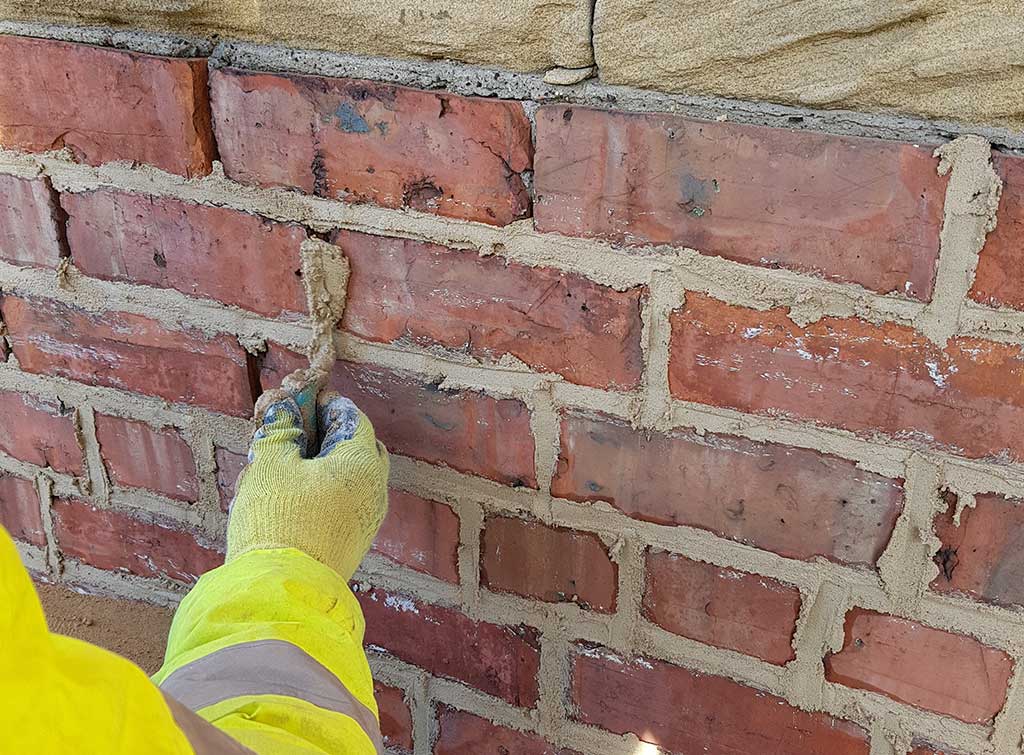
For the majority of crack causes, targeted repair methods restore the wall without removing and rebuilding the affected section. Crack stitching involves cutting slots across the crack line and inserting stainless steel helical bars bonded with structural resin. The slots are repointed over and the repair is invisible once finished. This method works well for stepped cracks and diagonal cracks where the masonry either side of the crack is otherwise sound.
Selective brick replacement handles spalling, frost-damaged, or physically broken bricks. Individual bricks are removed carefully, replacements are matched as closely as possible in colour, texture, and size, and the section is rebuilt with the correct mortar. Widespread spalling across a full elevation may require a more substantial programme, but the wall itself is not rebuilt from the ground up.
Lintel replacement and wall tie installation are more invasive repairs but still targeted. Both involve propping or drilling rather than stripping the wall back. Most Birmingham properties have had at least one of these repairs at some point in their life, often without the current owner knowing. The BRE Group’s crack assessment guide gives a useful reference for matching crack severity to the appropriate repair approach before any work is commissioned.
Conclusion: What to Do When Cracks Appear in Your Birmingham Home
Cracks in Birmingham brick walls are almost always caused by one of six things: ground movement in the city’s clay subsoil, failed wall ties in pre-1985 cavity walls, corroded steel lintels above openings, freeze/thaw damage to mortar joints, thermal movement in exposed sections, or active subsidence from roots or drainage problems. The crack pattern, width, location, and whether it is still growing all point toward the cause. That cause determines whether the repair is a bricklayer’s job or whether a structural engineer needs to be involved first.
For a full picture of what repair work involves and what it costs, the brickwork repair service page covers the main repair types in detail. Gora Bricklayers carries out free site assessments across Birmingham and the West Midlands. A local bricklayer who knows the property types and soil conditions in this city will give a more accurate read of a crack than any general guide can.
Frequently Asked Questions
1. Why are cracks appearing in my brick walls but not my neighbour’s identical house?
Two identical houses on the same street can crack very differently because the ground conditions beneath them are not always the same. Drainage is the most common reason. A leaking downpipe or broken drain on one property introduces water into the subsoil in a way that the neighbour’s dry drain does not. That water changes how the clay soil behaves beneath the affected foundation, causing movement that does not happen next door. Tree roots are another reason. A tree 6 metres from the front wall of one property affects its foundation in ways it does not affect a property 15 metres away. The depth and bearing of the foundations also varies. Properties extended, underpinned, or built with deeper footings at one point in their history behave differently from those that have never been touched. If the properties are Victorian or Edwardian terraces, the original build quality also varied significantly house by house, because bricks were hand-laid and mortar mixed on site without the consistency of modern construction. None of these differences are visible from the street. A site visit is the only way to identify which factor is driving the cracking on one property and not the other.
2. How do I know if a crack in my Birmingham home’s brick wall is getting worse?
The most reliable method is to apply a plaster or mortar tell-tale across the crack at its widest point. Smooth a small amount of filler or plaster over the crack, allow it to set fully, and mark the date next to it. Check it every four to six weeks. If the tell-tale cracks, the underlying crack is still moving. The direction in which the tell-tale breaks shows which way the movement is going. A simpler method is to mark the ends of the crack with a pencil line and date, measuring the length each time it is checked. Any increase in length or width over a monitoring period of three to six months confirms active movement. Cracks that widen in summer and narrow slightly in winter are typical of clay soil movement in Birmingham’s climate. That seasonal pattern is expected and does not necessarily indicate a serious structural problem. A crack that widens consistently across all seasons, or that grows suddenly after heavy rainfall or a very dry period, warrants professional assessment rather than continued monitoring alone.
3. What causes stepped cracks in brickwork on older Birmingham terraces?
Stepped cracks follow the mortar joints diagonally up the face of the wall in a staircase pattern. On older Birmingham terraces, this pattern almost always indicates differential foundation movement, where one part of the building has moved downward at a different rate from the section next to it. The crack steps along the weakest path through the wall, which is the mortar joint rather than through the brick itself. On Victorian terraces across Handsworth, Aston, and Sparkhill, this type of cracking is often linked to the clay subsoil shrinking during dry summers or swelling after wet winters. It can also be triggered by a leaking drain beneath or near the front footpath, which washes fine material away from the foundation over years. Tree roots close to the front of the property accelerate the process by drawing moisture from the clay. A stepped crack that appeared after an unusually dry summer and has not changed since is usually a historical movement crack that has stabilised. A stepped crack that continues to widen, or that is accompanied by sticking doors and windows, needs a professional assessment because the foundation movement is likely still active.
4. My brick wall has horizontal cracks running along the mortar joints. What does that mean?
Horizontal cracks running along the bed joints of a cavity wall at regular vertical spacings are one of the clearest signs of wall tie failure. The original iron or steel wall ties installed in Birmingham properties built before the mid-1980s corrode over time. As the rust builds up on the surface of the tie, it expands and forces the mortar joint above and below it apart. The result is a series of horizontal cracks across the outer leaf, typically spaced at the vertical intervals at which the ties were installed, usually around 450mm. The cracks may be accompanied by slight bulging of the outer leaf where the ties have expanded most. Wall tie failure is a structural problem because the connection between the inner and outer leaf of the wall has been broken. Repointing the cracks without replacing the ties does not solve the problem. The repair involves installing stainless steel replacement ties drilled through the outer leaf and into the inner leaf, then repointing the affected joints. A metal detector and borescope inspection confirms the extent of the tie failure before work begins. Left unaddressed, the outer leaf of the wall can eventually separate from the inner leaf and become unstable.
5. Can Birmingham’s wet winters make brick wall cracks worse over time?
Yes, and the mechanism is straightforward. Water enters an existing crack or a degraded mortar joint and saturates the material inside the wall. When the temperature drops below zero, that water freezes and expands by approximately 9 percent in volume. The expanding ice forces the crack wider or breaks apart the mortar that was still holding the joint together. When the temperature rises and the ice melts, the gap is slightly larger than it was before the freeze. The cycle repeats through each cold spell. Birmingham typically experiences multiple freeze/thaw cycles between November and March, with night-time temperatures regularly falling below zero even when daytime temperatures stay above. South and west-facing walls catch the most driving rain from Birmingham’s prevailing wind direction and are usually where freeze/thaw damage appears first. The practical implication is clear. A hairline crack in autumn can become a 3mm crack by February if it absorbs water through the autumn rains and then freezes. Getting any crack that has opened beyond 1mm repointed before winter removes the path through which water enters the wall in the first place.
6. Is a crack in my brick wall covered by home insurance?
Whether a crack is covered depends on the cause and the specific policy wording. Most standard home insurance policies in the UK cover subsidence damage, which includes cracking caused by ongoing foundation movement from causes such as clay soil shrinkage, tree root activity, or drainage failure beneath the foundations. However, insurers typically require a structural engineer’s report confirming that the cracking is subsidence-related before they authorise any repair work. They will also usually require a period of monitoring to confirm the movement is active rather than historical. Cracking caused by normal settlement, thermal movement, freeze/thaw damage, or failed wall ties is generally not covered as subsidence by home insurance, because these causes are classed as maintenance issues or gradual deterioration rather than sudden damage. This means the most common types of brick wall cracking in Birmingham properties are usually the homeowner’s responsibility to repair rather than an insurance matter. Where the cracking is severe and subsidence is suspected, the first step is to notify the insurer and request an assessment. Attempting to repair the wall before the insurer has assessed the damage can complicate or invalidate a claim.


